
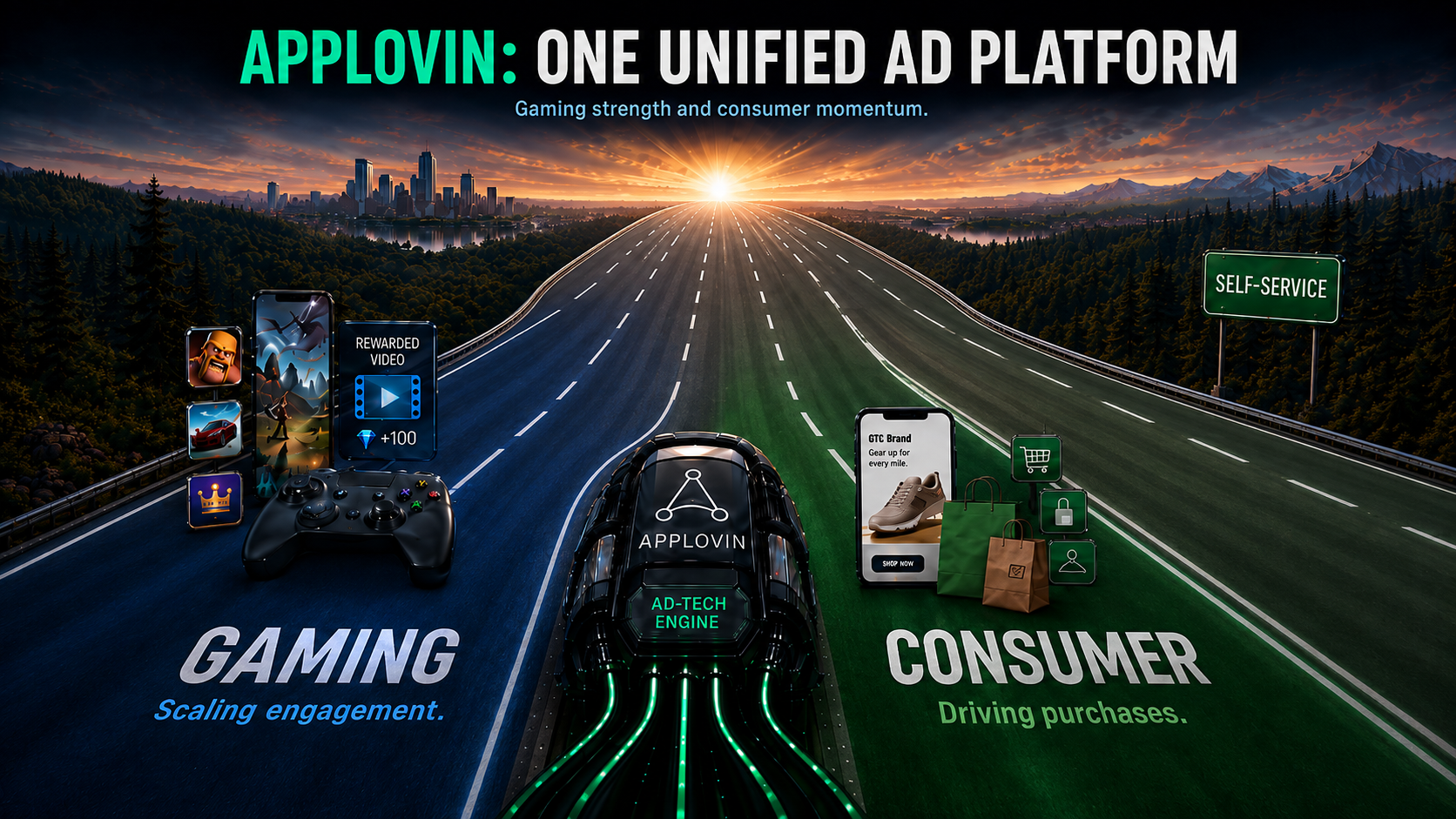
Let's look at how AppLovin is doing as it builds up its new non-gaming vertical and self-service platform. In this first post, I review Q1 results and frame what to expect in Q2. Next is a deep dive into the operating mechanics behind their strategic shift into e-commerce, and how it will flow into financials. Part 3 will cover Q2 results and the strategic priorities on the horizon.
- I was pleased with Q1 performance. They continue to show a gradual top-line slowdown as they scale, but I expect this slowdown to flatten out and turn into a reacceleration as self-service strengthens their flywheel.
- Overall revenue grew +59% to over $1.8B, and TTM grew +66% to $6.2B.
- My only concern was the notable deceleration in U.S. revenue growth, which had remained above 60% for the prior year before falling below 50% in Q1.
- Profitability remains jaw-dropping. TTM Adj EBITDA and GAAP net margins hit a record 83.3% and 63.5%. TTM FCF margins rose +4pp to 71.6%, putting them at a Rule of 138 TTM.
- They repurchased $1B in shares (about ~75% of FCF) and have $2.3B remaining under the authorization. Debt is not a concern.
- They continue to see momentum in non-gaming ads, which has now been dubbed their "Consumer vertical" housing e-commerce, DTC, and beyond. They rode holiday momentum into a surprisingly strong Q1, then implemented a significant model improvement in mid-April that lifted ROAS.
- They are also seeing renewed momentum in their core vertical. Gaming studios are now leveraging Generative AI to move faster, plus are starting to experiment with hybrid monetization strategies (IAP+ads) now that non-gaming ads are available.
- The self-service platform opened in late June and will not be a heavy factor in Q2 results beyond the continued beta.
- I worry about the market's understanding of their shift into consumer ads and the new self-service platform, and how (and how soon) the financial impacts will become visible. I believe there are some incorrect assumptions that have been muting its stock performance.
- However, Q2 should see a significant uplift in product ad performance from that model improvement in mid-April. This would provide a clear sign of their ongoing momentum and help counter any misconceptions about the self-service impacts.
Past coverage
If you need to catch up, I previously covered AppLovin in January and February.
- Ad nauseum (Jan-26) covered the mechanics of supply and demand in modern digital advertising, AppLovin's platform and how it dominated the mobile gaming ad market, and its big pivot into self-service consumer (e-commerce and DTC).
- Evolution of Axon ads (Feb-26) covered their evolution over 2022-2025 and strategic directions across Axon model improvements, e-commerce pilot, AI-generated creatives, and CTV.
- Mixed results from pilot (Feb-26) looked at the initial results of their e-commerce pilot.
- Also see my recent piece on Reddit's shifts (Jul-26), which looked at how AI search is changing discovery, resulting in "Google Zero" (zero click-throughs). I believe this is to AppLovin's benefit as a unique ad delivery platform over a niche audience of mobile gamers in a high-attention ad format.