
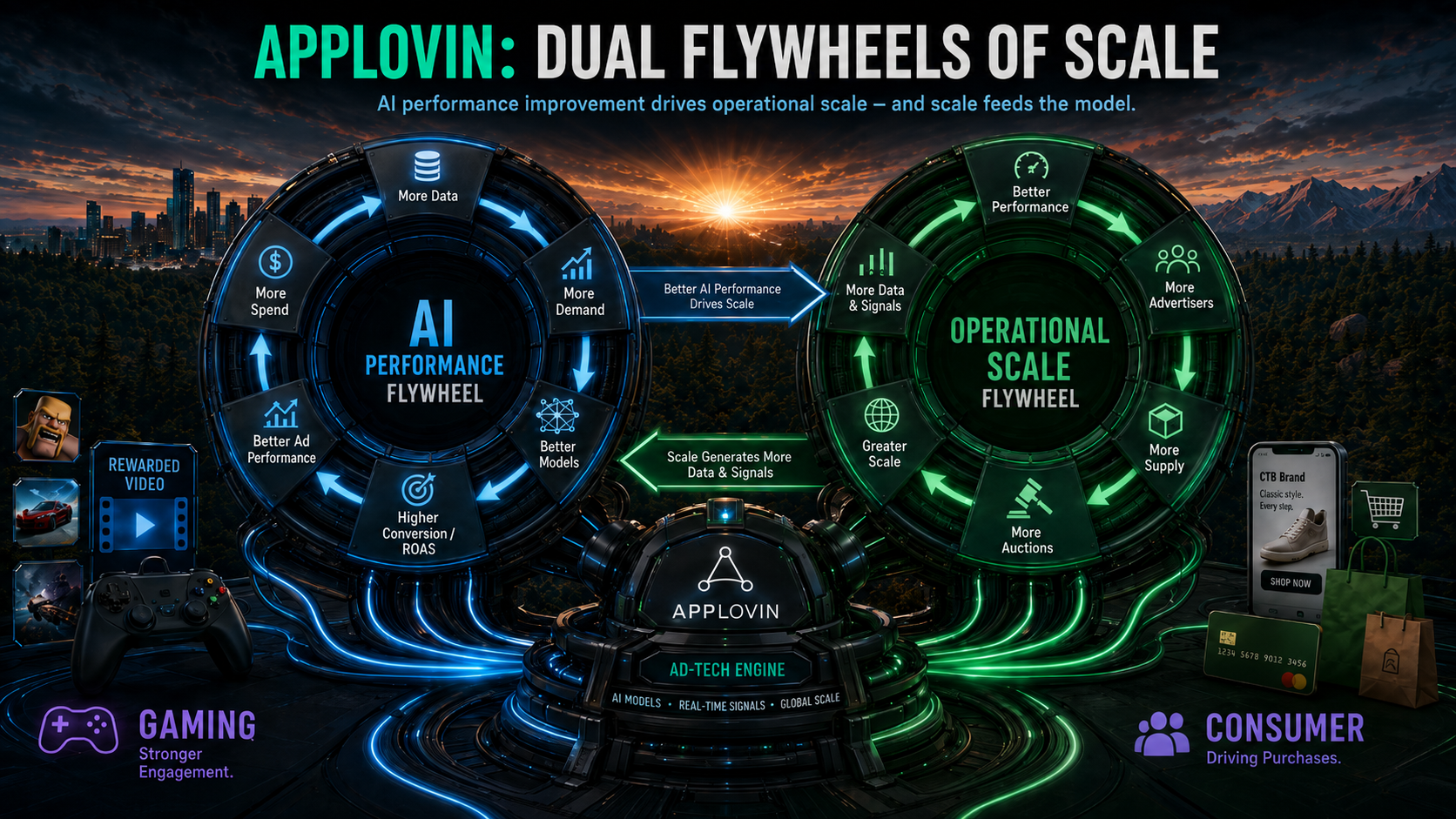
AppLovin has been executing on its core ad platform and AI improvement loop for years, providing ad solutions for mobile gaming studios across both supply (putting ads in your game to monetize it) and demand (showing ads for user acquisition). It is now expanding the demand side into non-gaming ads, with an initial focus on product ads for e-commerce and DTC brands.
As I noted in the Q2 preview, the June self-service launch should materially expand AppLovin’s long-term opportunity, although its contribution will likely develop incrementally rather than appear as a one-time inflection. To understand that opportunity, we first need to examine AppLovin’s revenue streams and how consumer advertising feeds its two reinforcing flywheels: continual AI improvement and operational execution.
- AppLovin monetizes both sides of its advertising marketplace: earning a cut of publisher ad revenue on the supply side and performance fees from advertisers on the demand side.
- The core economics depend on the spread between what AppLovin earns from successful conversions and what it pays publishers for the underlying ad impressions.
- Axon's predictive performance is the key lever. Even modest conversion rate improvements can materially increase advertiser returns, AppLovin’s demand-side revenue, and the value of its existing inventory.
- AppLovin’s expansion into consumer advertising and the launch of self-service should bring a much larger and more diverse set of advertisers, products, creatives, and campaigns onto the platform.
- That increased demand density in consumer ads should help monetize impressions that currently generate little value for gaming ads. Gaming ads can be served more selectively when users are most likely to convert.
- Consumer advertising should complement rather than cannibalize gaming: broader data improves ad matching across both verticals, while gaming advertisers retain the highest-converting impressions.
- This creates an AI flywheel in which more advertisers and campaign diversity generate more conversion data, which in turn improves Axon's models and ad performance.
- Improved performance then drives a second, executional flywheel: higher advertiser ROAS leads to larger bids and budgets, higher publisher yields, more ad placements, and additional supply & demand.
- The initial financial benefit may come from higher auction prices and supply-side revenue, but the larger long-term opportunity is demand-side growth as conversion rates improve.
- If demand-side revenue grows faster than publisher payouts, AppLovin could widen its economic spread, accelerate revenue growth, and further expand its already exceptional margins.
However, mgmt has been giving us the occasional clue, and I, for one, am getting a lot more comfortable in my understanding of their mechanics.